
Professional Solar Panel Cleaning: Complete 2026 Guide
Last Updated: August 18, 2026
🤖 AI Overview Quick Summary
Professional solar panel cleaning removes dust, pollen, bird droppings, mud, mineral deposits and other soiling that can reduce the amount of sunlight reaching photovoltaic cells. The safest cleaning method depends on the panel manufacturer’s instructions, the type of contamination, roof access and local conditions. In most cases, homeowners should avoid abrasive tools, scraping dry dirt and unnecessary high-pressure cleaning. A soft, non-abrasive cleaning method using suitable water can help maintain clean glass without damaging the module surface.
Quick answer: Solar panels do need cleaning when accumulated dirt is affecting performance or when visible contamination is difficult to remove naturally. However, there is no single cleaning schedule that works for every system. NREL recommends considering local soiling conditions and the cost of cleaning against the energy lost from dirty panels.
Introduction
Solar panels are designed to operate outdoors for many years with relatively little routine maintenance. However, that does not mean the glass surface should be ignored.
Dust, pollen, bird droppings, construction debris, leaves, soot and dried rain deposits can gradually build up on photovoltaic modules. When this soiling becomes significant, less sunlight reaches the solar cells, which can affect energy production.
That is where professional solar panel cleaning becomes useful.
This guide is written for residential homeowners, commercial property owners, solar system operators and property managers who want to understand when solar panels need cleaning, how to clean them safely, what mistakes to avoid, how often panels should be cleaned and when professional service makes more sense than DIY maintenance.
The goal is not simply to make solar panels look cleaner. The goal is to maintain the glass surface, protect the equipment and help the system continue producing energy efficiently.
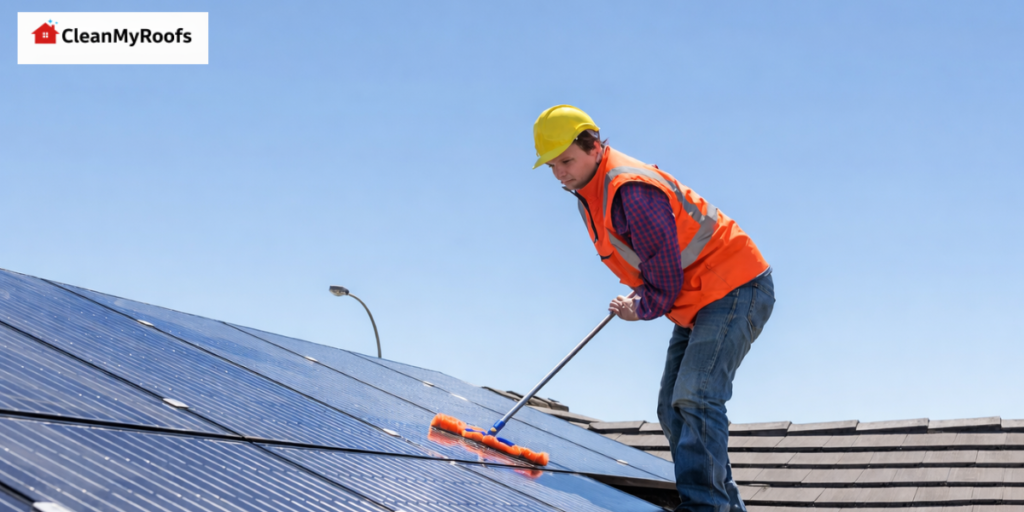
Why Do Solar Panels Need Cleaning?
Solar panels are continuously exposed to outdoor conditions. Even when the modules look relatively clean from the ground, a thin layer of material can accumulate across the glass.
Common sources of solar panel soiling include:
- Dust and dirt
- Pollen
- Bird droppings
- Leaves and organic debris
- Construction dust
- Agricultural dust
- Diesel or industrial soot
- Dried rainwater deposits
- Mud splashes
- Airborne pollution
NREL identifies agricultural dust, construction dust, pollen, bird activity, diesel soot and industrial sources among the common causes of PV soiling.
The important point is that not every solar panel needs to be cleaned at the same frequency.
A system in a clean environment that receives regular rainfall may need little intervention, while panels near construction, agricultural activity, heavy traffic or persistent dust may require more frequent cleaning.
How Dirty Solar Panels Affect Energy Production
Soiling reduces the amount of light that reaches the photovoltaic cells.
The effect varies considerably depending on:
- Type of dirt
- Thickness of the buildup
- Panel angle
- Weather
- Rainfall
- Local dust levels
- Bird activity
- Nearby construction
- System design
NREL notes that soiling can reduce PV energy output and that cleaning schedules should be based on site conditions and the economics of cleaning versus the energy loss caused by soiling.
This is why simply saying that every homeowner should clean solar panels every month is not technically appropriate.
A better approach is to monitor the system and inspect the panels regularly.
If production drops unexpectedly and weather conditions do not explain the decline, soiling is one factor worth investigating.
How Often Should Solar Panels Be Cleaned?
There is no universal number of cleanings per year.
Some systems may only need occasional cleaning, while heavily exposed arrays may require more frequent service.
Consider cleaning when:
- You can clearly see heavy dust or dirt on the glass.
- Bird droppings cover active areas of the panel.
- Rain has left significant mineral or mud deposits.
- The system is located near construction.
- Pollen has accumulated heavily.
- Production is lower than expected without another obvious explanation.
- The panels have not been inspected for an extended period.
NREL’s O&M guidance describes PV cleaning as condition-dependent rather than automatically requiring one fixed interval for every system.
A Practical Cleaning Schedule
A simple starting framework is:
| Environment | Suggested Approach |
|---|---|
| Low-dust residential area | Inspect periodically and clean when needed |
| Heavy dust exposure | Inspect more frequently |
| Construction nearby | Clean after significant dust events |
| High bird activity | Spot-clean droppings when necessary |
| Heavy pollen season | Inspect after the season |
| Frequent rainfall | Allow natural cleaning where effective |
| Persistent visible soiling | Professional cleaning may be appropriate |
The correct schedule should always account for the manufacturer’s maintenance instructions and actual site conditions.
Does Rain Clean Solar Panels?
Rain can help remove loose dust and some surface contamination.
However, rain is not always a complete cleaning solution.
Rainwater can combine with dust and leave:
- Mud streaks
- Mineral deposits
- Water spots
- Dirt around panel frames
- Bird-dropping residue
Some manufacturers specifically note that sufficiently tilted modules may receive a self-cleaning benefit from rainfall, while recommending periodic maintenance when soiling occurs.
NREL likewise recommends comparing natural cleansing with paid cleaning based on local rainfall and soiling conditions.
So the better question is not simply “Does rain clean solar panels?”
It is:
“Are my panels actually clean enough after rainfall to maintain normal performance?”
What Is the Best Way to Clean Solar Panels?
The safest method depends on the panel manufacturer’s instructions.
For many systems, a basic cleaning approach involves:
- Inspecting the panels first.
- Checking the manufacturer’s cleaning requirements.
- Removing loose debris carefully.
- Using suitable water.
- Using a non-abrasive cleaning tool when necessary.
- Rinsing the surface thoroughly.
- Allowing the panels to dry without leaving excessive mineral residue.
Canadian Solar’s current installation guidance recommends low-mineral-content water and non-abrasive cleaning tools when wet cleaning is necessary.
The most important principle is simple:
Clean the glass without scratching, scraping or unnecessarily stressing the module.
Why Water Quality Matters During Solar Panel Cleaning
Water quality is an important consideration because ordinary water can contain dissolved minerals.
When mineral-rich water evaporates from glass, it can leave visible deposits.
These deposits may appear as:
- White spots
- Cloudy patches
- Mineral rings
- Chalky residue
- Water marks
For professional cleaning, low-mineral or deionized water can be useful because it reduces the likelihood of mineral residue after drying.
However, the appropriate water and cleaning process should always follow the panel manufacturer’s instructions.
Should You Use a Pressure Washer on Solar Panels?
Pressure washing is generally not the first choice for photovoltaic module cleaning.
A pressure washer introduces unnecessary mechanical force and can create risks around:
- Module seals
- Frames
- Wiring
- Connectors
- Electrical components
- Mounting hardware
The exact allowable pressure varies by manufacturer, so the manufacturer’s documentation should always take priority.
For example, Canadian Solar provides specific pressure and cleaning-tool guidance in its current module documentation.
For homeowners, the safest rule is:
Do not assume that a pressure washer is safe simply because the panel glass looks strong.
Can You Use Soap to Clean Solar Panels?
Sometimes, but only when the manufacturer’s instructions permit it.
The cleaning product should be:
- Non-abrasive
- Appropriate for photovoltaic modules
- Compatible with the manufacturer’s surface requirements
- Thoroughly rinsed away
Some manufacturer guidance allows mild cleaning agents under specific circumstances, while other systems may recommend water-based cleaning.
Always check the module documentation before applying a detergent.
What Should You Never Use to Clean Solar Panels?
Avoid improvised cleaning methods that can scratch or damage the module.
Do not use:
- Metal scrapers
- Abrasive pads
- Harsh solvents
- Aggressive scouring products
- Rough brushes
- Dry scraping of stuck-on dirt
- Unapproved chemical cleaners
Canadian Solar specifically advises against abrasive cleaning methods and recommends non-abrasive tools for wet cleaning.
Why Dry Scraping Is a Bad Idea
Dry dirt can contain small mineral particles.
Dragging a scraper or rough brush across the glass can turn those particles into an abrasive layer.
That can create fine scratches that are much harder to correct than ordinary dirt.
What About Bird Droppings on Solar Panels?
Bird droppings deserve special attention because they can cover a concentrated portion of the panel surface.
A small amount of contamination can create a localized obstruction even when the rest of the module is relatively clean.
The safest approach is to soften the contamination rather than aggressively scraping it away.
Avoid:
- Metal tools
- Dry scraping
- Abrasive pads
- Excessive pressure
If bird activity is persistent, the underlying problem may also need to be addressed.
NREL identifies bird populations and droppings as an important source of PV soiling and recommends considering preventive measures where appropriate.
Can Dust Cause Solar Panels to Produce Less Power?
Yes.
Dust and other surface contamination reduce the amount of sunlight reaching the photovoltaic cells.
The actual production loss varies by:
- Amount of soiling
- Type of particles
- Weather
- Panel orientation
- Tilt
- Cleaning frequency
- System design
NREL’s current O&M guidance notes that soiling can reduce energy output and lists dust, pollen, bird droppings, construction dust and industrial sources among common causes.
This is why solar panel cleaning and maintenance should be considered part of overall PV system care rather than simply an appearance-related service.
How to Know When Solar Panels Need Cleaning
You do not always need special equipment to identify obvious soiling.
Look for:
Visible Dirt
A dull or dusty appearance across the glass is an obvious warning sign.
Bird Droppings
Large or repeated deposits can create localized shading.
Mud or Rain Marks
Dried rainwater can leave deposits that remain after the weather clears.
Pollen
Yellow or greenish films may appear during heavy pollen periods.
Unexpected Production Changes
Check your inverter or monitoring application.
If production is consistently lower than expected after accounting for weather and seasonal changes, investigate the cause.
The U.S. Department of Energy recommends monitoring PV system performance over time as part of proper O&M.
Solar Panel Cleaning vs. Solar Panel Maintenance
Cleaning is only one part of solar maintenance.
A broader maintenance program can include:
- Panel cleaning
- Visual inspection
- Mounting hardware inspection
- Cable inspection
- Connector inspection
- Inverter monitoring
- Debris removal
- Storm inspection
- Performance monitoring
The U.S. Department of Energy recommends preventive O&M, performance monitoring and pre-storm maintenance as part of PV system management.
This distinction matters because cleaning cannot fix an electrical or mechanical fault.
If the inverter is repeatedly tripping, production suddenly stops, wiring appears damaged or a panel is physically cracked, the problem requires appropriate solar-system inspection and repair.
What Should You Do After a Storm?
After severe weather, inspect the system from a safe location.
Look for:
- Shifted panels
- Damaged mounting hardware
- Loose cables
- Visible cracks
- Debris
- Fallen branches
- Water or roof damage
Do not climb onto a damaged roof to investigate a suspected electrical problem.
The Department of Energy’s PV maintenance guidance recommends pre-storm planning and post-damage inspection, including securing damaged areas and testing systems before returning them to service.
Can You Clean Solar Panels Yourself?
DIY cleaning may be reasonable when the panels are easily accessible and the cleaning method is compatible with the manufacturer’s instructions.
However, roof-mounted systems can create serious fall and electrical hazards.
Professional service makes more sense when:
- Panels are on a steep roof.
- Access requires climbing.
- The array is large.
- Panels are difficult to reach.
- There is heavy contamination.
- Mineral deposits are difficult to remove.
- You are unsure which cleaning method your panels require.
- You want cleaning combined with a visual maintenance inspection.
Never stand on solar panels to clean them.
Professional Solar Panel Cleaning: What Should a Service Include?
A quality professional solar panel cleaning service should focus on more than simply spraying water across the array.
Depending on the service provider and system, the process may include:
- Initial visual inspection
- Identification of contamination
- Review of panel-access conditions
- Appropriate water selection
- Non-abrasive cleaning
- Thorough rinsing
- Inspection for visible damage
- Basic performance observation
- Final visual check
A professional should also understand when not to clean aggressively.
The objective is to remove contamination without creating a new problem.
How Much Does Solar Panel Cleaning Cost?
There is no single universal solar panel cleaning price.
Cost usually depends on:
- Number of panels
- System size
- Roof height
- Roof pitch
- Accessibility
- Amount of contamination
- Cleaning method
- Required safety equipment
- Residential or commercial installation
- Whether inspection or maintenance is included
For that reason, a professional quote should be based on the actual system rather than a generic price.
If you are comparing solar panel cleaning services, ask whether the quoted price includes:
- Full panel cleaning
- Water treatment
- Equipment setup
- Safety access
- Basic inspection
- Post-cleaning rinse
- Any additional maintenance
Does Solar Panel Cleaning Improve ROI?
It can, but the economics depend on the amount of soiling and the cost of cleaning.
NREL specifically recommends comparing the expected energy loss from soiling with the cost of cleaning before establishing a cleaning program.
For example, cleaning makes more economic sense when:
- The array is heavily soiled.
- Energy production is measurably affected.
- Cleaning costs are reasonable.
- The system produces significant energy.
- The site accumulates dirt quickly.
Conversely, a lightly soiled system that receives frequent rainfall may not justify frequent paid cleaning.
This is why a condition-based solar panel cleaning schedule is often more practical than automatically scheduling the same number of cleanings every year.
Original Experience: How to Evaluate Whether Cleaning Is Actually Working
One of the best ways to evaluate solar panel cleaning is to compare the system before and after service instead of relying only on visual appearance.
For a practical maintenance record, note:
- Date of cleaning
- Weather conditions
- Visible contamination
- System size
- Energy production before cleaning
- Energy production after cleaning
- Any visible panel damage
- Any inverter warnings
- Next recommended inspection date
For example, a homeowner can record the monitoring application’s production data for several comparable days before cleaning and compare it with subsequent production after cleaning, while accounting for weather and sunlight conditions.
This creates a useful before-and-after solar panel cleaning record instead of assuming that cleaner glass automatically means a specific percentage increase in production.
That approach is consistent with the broader PV O&M principle of monitoring actual system performance over time.
A Simple Solar Panel Cleaning Checklist
Use this checklist before scheduling or performing maintenance:
Before Cleaning
- Check the manufacturer’s cleaning instructions.
- Inspect the array from a safe position.
- Check for cracks or visible damage.
- Look for bird nests or heavy debris.
- Review recent energy production.
- Confirm safe roof access.
During Cleaning
- Avoid abrasive materials.
- Avoid dry scraping.
- Use suitable water.
- Use appropriate non-abrasive tools.
- Avoid unnecessary pressure.
- Keep electrical safety in mind.
After Cleaning
- Check the glass for remaining deposits.
- Confirm the panels are free of obvious residue.
- Review system operation.
- Record the service date.
- Monitor production afterward.
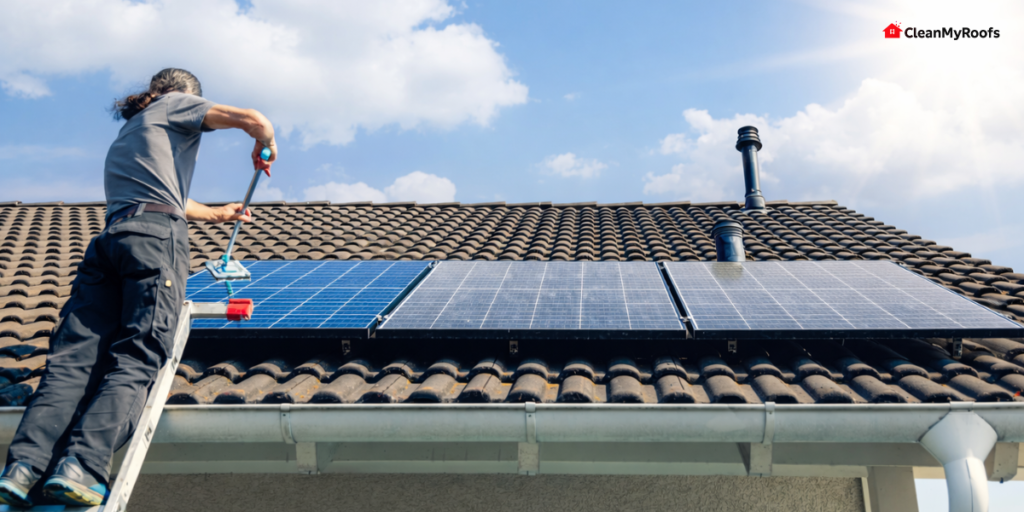
Frequently Asked Questions
How often should solar panels be cleaned?
Solar panels should be cleaned when environmental soiling becomes significant enough to affect the surface or system performance. Cleaning frequency depends on dust, pollen, bird activity, rainfall, nearby construction and other site conditions. NREL recommends condition-based cleaning rather than assuming every system requires the same fixed schedule.
What is the best way to clean solar panels?
The best method depends on the manufacturer’s instructions. In general, use a non-abrasive approach with suitable water and avoid scraping dry contamination across the glass. Some manufacturers recommend low-mineral water and non-abrasive tools for wet cleaning.
Can I use a pressure washer on solar panels?
Pressure washing should not be treated as a universal cleaning method for photovoltaic modules. High-pressure equipment can introduce unnecessary stress around seals, frames and electrical components. Always follow the specific module manufacturer’s cleaning requirements.
Does rain clean solar panels?
Rain can naturally remove loose dust and reduce the need for manual cleaning, especially on sufficiently tilted modules. However, rain can also leave mud, mineral deposits and other residue. Whether additional cleaning is necessary depends on the actual condition of the panels.
Do dirty solar panels produce less electricity?
Yes. Surface soiling can reduce the amount of sunlight reaching photovoltaic cells and therefore reduce energy output. The size of the loss depends on the type and amount of contamination and the environmental conditions.
Can I clean solar panels myself?
DIY cleaning may be possible when the array is safely accessible and the manufacturer’s instructions allow it. However, roof access and electrical hazards make professional service the better option for many rooftop systems.
How much does professional solar panel cleaning cost?
The cost depends on system size, panel count, roof access, contamination, cleaning method and whether inspection or additional maintenance is included. A site-specific quote is more reliable than a universal per-panel price.
Do solar panels need maintenance besides cleaning?
Yes. Solar maintenance can include performance monitoring, visual inspections, wiring checks, mounting inspections, debris removal and post-storm assessment. The U.S. Department of Energy recommends preventive O&M and ongoing performance monitoring for PV systems.
Final Thoughts
Solar panels are designed for long-term outdoor operation, but they are not completely maintenance-free.
Dust, pollen, bird droppings, construction debris, pollution and dried rain deposits can accumulate on photovoltaic glass and interfere with light reaching the cells. The right response is not necessarily to clean the panels as frequently as possible. Instead, homeowners and property managers should use a condition-based solar panel cleaning strategy that considers visible soiling, energy production, rainfall, site conditions and manufacturer recommendations.
For difficult-to-access arrays or heavily contaminated panels, professional solar panel cleaning provides a safer way to restore the glass surface while reducing the risk of damage from inappropriate tools or cleaning methods.
For broader exterior maintenance, you can also combine solar panel care with our soft washing services when the surrounding roof and exterior surfaces need gentle cleaning.
If mineral deposits have affected nearby exterior glass, our hard water spot removal service can address those deposits separately.
For roof-related maintenance, see our roof cleaning services to keep the surrounding roof surface maintained without making the solar panel article itself a location-targeted page.
Ready to discuss your solar panel cleaning needs? Contact CleanMyRoofs at 877-565-4094 for a professional assessment and cleaning quote.