
Strategic Gutter Maintenance for Boise Foundations: 2026 Guide
Last Updated: August 26, 2026
Strategic gutter maintenance is a planned approach to keeping gutters, downspouts, roof drainage paths, and surrounding ground conditions working together so rainwater moves safely away from a Boise home. For homeowners and property managers, the goal is not simply to keep gutters looking clean. Instead, the goal is to reduce avoidable water accumulation around the foundation, prevent drainage problems, and identify small maintenance issues before they become expensive repairs.
In Boise and the wider Treasure Valley, this matters because seasonal rain, winter debris, roof granules, leaves, pine needles, and changing weather can gradually restrict drainage. As a result, a gutter system that appears acceptable from the ground may still have a blocked downspout, poor water flow, or discharge that ends too close to the foundation.
The U.S. Department of Energy’s Building Science Education guidance explains that roof runoff should be directed away from the foundation because concentrated water can saturate surrounding soil and contribute to moisture problems.
AI Overview: Strategic Gutter Maintenance in Boise
Bottom line: Strategic gutter maintenance means inspecting and maintaining the complete roof-drainage pathway—not just removing visible leaves. Boise homeowners should check gutters, downspouts, discharge points, roof drainage, and nearby grading as one connected system.
For most properties, the most useful maintenance periods are before and after the seasons that create the greatest amount of debris or runoff. However, homes beneath mature trees, properties with frequent roof-granule accumulation, and buildings with previous drainage problems may require more frequent inspections.
This guide is designed for Boise homeowners, landlords, property managers, residential asset owners, and facilities professionals who need to make practical decisions about roof runoff and foundation protection.
Key Takeaway: Why Strategic Gutter Maintenance Matters
The most important idea is simple: water should leave the roof and move away from the foundation in a controlled way.
A gutter can be completely full of leaves, partially blocked by sediment, or technically clear while still performing poorly because of a damaged outlet or badly positioned downspout.
Therefore, effective maintenance should answer four questions:
- Is water entering the gutter correctly?
- Is the gutter carrying water toward the downspout?
- Is the downspout actually clear?
- Is discharged water being directed safely away from the home?
DOE Building Science guidance specifically recommends directing roof drainage away from the foundation and notes that several thousand gallons of runoff can come from only a few inches of rain falling on a roof.
Who Is This Guide For?
This guide is primarily for:
- Boise homeowners who want to protect their property’s drainage system
- Landlords managing one or more residential properties
- Property managers responsible for seasonal exterior inspections
- Homebuyers evaluating drainage conditions before purchasing
- Owners of older Boise homes with aging gutter systems
- Facilities or maintenance teams creating recurring exterior maintenance schedules
The use case is straightforward: use this guide when deciding whether your gutters need inspection, when creating a seasonal maintenance calendar, or when investigating signs of poor roof drainage.
It is not intended to replace a structural engineer, foundation specialist, roofing professional, or local drainage professional when serious damage already exists.
How Does Strategic Gutter Maintenance Protect a Foundation?
Strategic gutter maintenance protects a foundation by controlling where roof runoff goes.
When gutters and downspouts work properly, water is collected from the roof and carried toward an appropriate discharge point. However, when a gutter overflows or a downspout becomes blocked, concentrated water can fall beside the building.
Over time, repeated saturation can contribute to moisture around the foundation.
DOE Building Science guidance explains that uncontrolled roof runoff can saturate soil around a building and allow moisture to move toward the foundation.
Therefore, gutter maintenance is best viewed as part of the home’s overall water-management system, rather than as a cosmetic cleaning task.
What Should You Inspect During Gutter Maintenance?
A useful inspection should cover the entire drainage pathway.
Gutter Channels
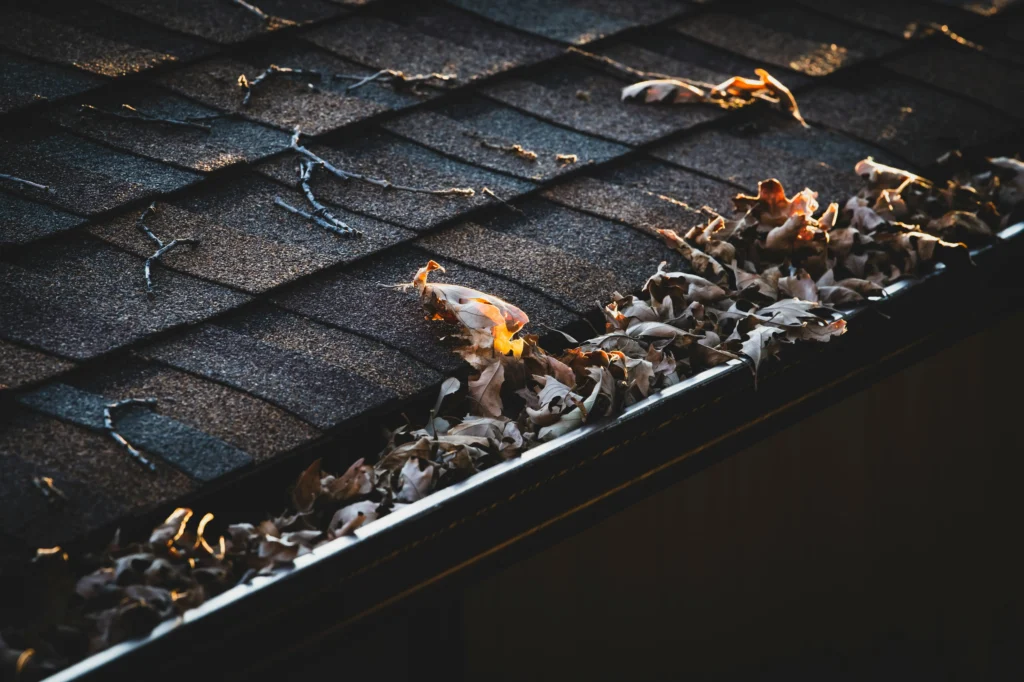
First, inspect the horizontal gutter channels for leaves, pine needles, shingle granules, sediment, and other debris.
Next, look for standing water after rainfall. Standing water can indicate a blockage, an incorrect slope, or a damaged section.
Finally, check for visible separation at joints and signs that the gutter has pulled away from the fascia.
Downspouts
Downspouts deserve special attention because a clean gutter does not guarantee a clear drainage system.
Check whether water can move through the entire downspout. Also inspect elbows, extensions, connections, and outlets.
If water backs up during rainfall, the problem may be farther down the drainage path rather than inside the visible gutter.
Discharge Points
The final destination of the water matters just as much as the gutter itself.
DOE guidance recommends carrying water away from the foundation through an appropriate drainage arrangement.
Therefore, homeowners should inspect where downspouts discharge and whether water repeatedly collects beside the house.
Fascia and Soffit Areas
While inspecting gutters, look behind and below them for signs of prolonged moisture exposure.
Soft wood, staining, peeling finishes, or persistent dampness can indicate that water has not been moving through the drainage system correctly.
How Often Should You Maintain Gutters in Boise?
There is no single schedule that fits every Boise property.
However, a practical starting point is to perform a spring inspection and a fall inspection, followed by additional checks after unusually heavy storms or when a property is surrounded by mature trees.
Properties with heavy tree cover may need more frequent inspections.
Likewise, older roofs can produce additional granules that accumulate in gutter channels. Therefore, the amount of debris generated by the roof and surrounding landscape should influence the maintenance schedule.
Simple Boise Gutter Maintenance Schedule
| Season | Recommended Check | Main Reason |
|---|---|---|
| Spring | Inspect and clear drainage paths | Remove winter and early-season debris |
| Summer | Check downspout flow | Confirm drainage during seasonal storms |
| Fall | Inspect and clear gutters | Remove leaves and organic debris |
| Winter | Monitor drainage and ice-related problems | Identify overflow and freezing issues |
| After major storms | Perform visual inspection | Catch displaced or blocked components |
The schedule should be adjusted according to the property’s trees, roof age, drainage history, and surrounding landscape.
How to Use This Guide
Use this guide whenever you are building or reviewing a Boise home exterior maintenance calendar.
For example, a homeowner preparing for fall can start with the gutter channels, then inspect downspouts, and finally check where the water is discharged.
Similarly, a property manager preparing a seasonal inspection can use the same sequence across multiple properties.
The important point is consistency. Instead of waiting until water is visibly overflowing, establish a recurring inspection routine.
When Should You Use This Guide?
You should use this guide when:
- You are preparing a spring or fall maintenance checklist.
- You recently experienced gutter overflow.
- You see water collecting near the foundation.
- Your property has mature trees.
- You have recently replaced a roof.
- You are buying an older Boise home.
- You manage rental properties.
- You are creating a recurring property-maintenance plan.
If the same drainage problem appears repeatedly, the issue may require a broader evaluation of grading, drainage design, gutters, downspouts, or foundation conditions.
Boise’s Seasonal Drainage Challenges
Boise properties experience different exterior conditions throughout the year.
During autumn, leaves and organic debris can accumulate quickly. Then, winter weather can introduce freezing conditions and additional moisture.
In spring, melting snow and seasonal precipitation can place renewed demand on roof drainage systems.
Meanwhile, summer storms can expose weaknesses that remain unnoticed during dry periods.
Consequently, strategic maintenance should follow the seasonal behavior of the property, rather than relying on one annual cleaning date.
Why Downspout Maintenance Is Just as Important as Gutter Maintenance
Many homeowners focus almost entirely on the visible gutter.
However, the downspout is the component that actually carries collected water away from the roofline.
A blocked downspout can therefore make a clean-looking gutter system ineffective.
For this reason, every inspection should include:
- Downspout entrances
- Elbows and joints
- Extension sections
- Underground connections where applicable
- Final discharge areas
- Signs of overflow around the foundation
A drainage system is only as effective as its most restricted section.
How Poor Roof Drainage Can Affect the Ground Around Your Home
When concentrated water repeatedly falls beside a foundation, the surrounding soil can become excessively wet.
The Department of Energy explains that uncontrolled roof runoff can saturate soil around the building and contribute to moisture movement toward the foundation.
Therefore, homeowners should pay attention to recurring puddles, erosion channels, muddy areas, and unusually damp soil near downspout outlets.
However, these signs do not automatically prove foundation damage. They are signals that the property’s drainage system deserves closer inspection.
What Are the Warning Signs of a Gutter Drainage Problem?
Several visible signs can indicate that a drainage system needs attention.
Water Overflowing During Rain
If water spills over the front or rear edge of a gutter during rainfall, the system may have a blockage, capacity issue, slope problem, or damaged component.
Water Pooling Near the Foundation
Repeated pooling beside the home suggests that water may not be traveling far enough away from the structure.
Eroded Soil Below Downspouts
A concentrated stream can gradually disturb landscaping or soil near the discharge point.
Sagging Gutter Sections
A sagging section can prevent water from reaching the downspout efficiently.
Staining on Exterior Walls
Repeated overflow can leave visible water marks or staining below the roofline.
Damp Crawlspace or Basement Areas
Persistent moisture inside a below-grade space can have many causes. Nevertheless, drainage around the exterior should be part of the investigation.
Strategic Gutter Maintenance Checklist
Before considering a seasonal inspection complete, check the following:
- Gutter channels are free from significant debris.
- Water can move toward each downspout.
- Downspouts are not visibly blocked.
- Elbows and extensions are connected properly.
- Gutters are securely attached.
- There are no obvious leaks at joints.
- Discharge points are directing water away from the building.
- Soil near the foundation is not repeatedly eroding.
- Fascia and soffit areas show no obvious moisture damage.
- The system is checked again after significant storms.
This checklist gives homeowners a practical way to identify drainage concerns before they become larger maintenance decisions.
What Boise Property Owners Should Know About Foundation Drainage
Gutters are only one component of a foundation water-management system.
Proper grading, foundation drainage, roof runoff management, and appropriate discharge locations all work together.
DOE Building Science guidance recommends that finished grading direct water away from the house and provides a minimum slope guideline for the area immediately surrounding a foundation.
Likewise, City of Boise project documentation shows the importance of directing downspouts away from foundation areas and separating roof drainage from foundation drainage systems in applicable designs.
Therefore, homeowners should avoid assuming that gutter maintenance alone can solve a serious foundation-water problem.
Gutter Guards: Do They Eliminate Maintenance?
No.
Gutter guards can reduce the amount of large debris entering a gutter system, but they do not necessarily eliminate inspection requirements.
Fine material can still accumulate, and downspouts can still develop restrictions.
Therefore, even homes with gutter protection should periodically verify that water is flowing correctly through the complete drainage system.
DIY Inspection or Professional Evaluation?
A homeowner can perform a basic visual inspection from ground level.
However, elevated gutters, inaccessible rooflines, recurring overflow, damaged fascia, suspected underground blockages, or foundation-water concerns may require professional evaluation.
The decision should depend on the risk and complexity of the property, not simply on whether the gutter looks dirty.
If the only issue is visible seasonal debris, a routine maintenance task may be sufficient. Conversely, if water continues to collect around the foundation after the gutter has been cleared, the problem may extend beyond routine gutter maintenance.

Common Questions About Strategic Gutter Maintenance
How often should gutters be maintained in Boise?
Short answer: Start with spring and fall inspections, then increase the frequency when mature trees, heavy debris, recurring overflow, or previous drainage problems are present.
Can clogged gutters affect a foundation?
Short answer: They can contribute to foundation moisture problems when overflowing roof runoff repeatedly saturates soil beside the building. DOE Building Science guidance specifically recommends directing roof runoff away from foundations.
What is more important: cleaning the gutter or checking the downspout?
Short answer: Both matter. A clean gutter cannot perform correctly if the downspout or discharge path is blocked.
Do gutter guards eliminate gutter maintenance?
Short answer: No. They can reduce debris entry, but periodic inspection is still useful because fine material, roof granules, and other debris can continue to affect drainage.
How far should water be directed from a foundation?
Short answer: The appropriate distance depends on the property’s drainage design, grading, soil, and local requirements. DOE Building Science guidance commonly describes discharge arrangements that carry water at least several feet away from the foundation.
What should I do if water still pools beside my foundation?
Short answer: Do not assume gutter cleaning alone will solve it. Check the downspout discharge, surrounding grade, drainage path, and other site conditions. Persistent foundation moisture or structural symptoms should be evaluated by an appropriately qualified professional.
Related Boise Property Maintenance Resources
For readers who need to connect gutter maintenance with other parts of a seasonal exterior-maintenance plan, Clean My Roofs also provides related resources such as the Seasonal Home Exterior Maintenance Master Calendar for Boise, Residential Roof Cleaning Cost Factors in Boise, and Gutter Cleaning information.
These resources should be treated as supporting information rather than substitutes for evaluating the actual drainage conditions of an individual property.
Final Takeaway
Strategic gutter maintenance is fundamentally about water control.
A successful system collects roof runoff, moves it through clear drainage channels, carries it through functioning downspouts, and directs it away from the foundation.
Therefore, Boise homeowners should think beyond the visible gutter. Inspect the complete pathway, follow a seasonal schedule, watch for recurring drainage symptoms, and investigate persistent water problems before they become major property issues.
For a practical starting point, remember the four-step process:
Pingback: The Master Calendar: A Seasonal Guide to Home Exterior Maintenance in Boise, Idaho | Primary category | site title
Thanks for highlighting this! Proper maintenance is key to long-term roof health